Showing posts with label longcase clock. Show all posts
Saturday, 10 August 2013
Monday, 1 July 2013
Tuesday, 17 November 2009
Next:
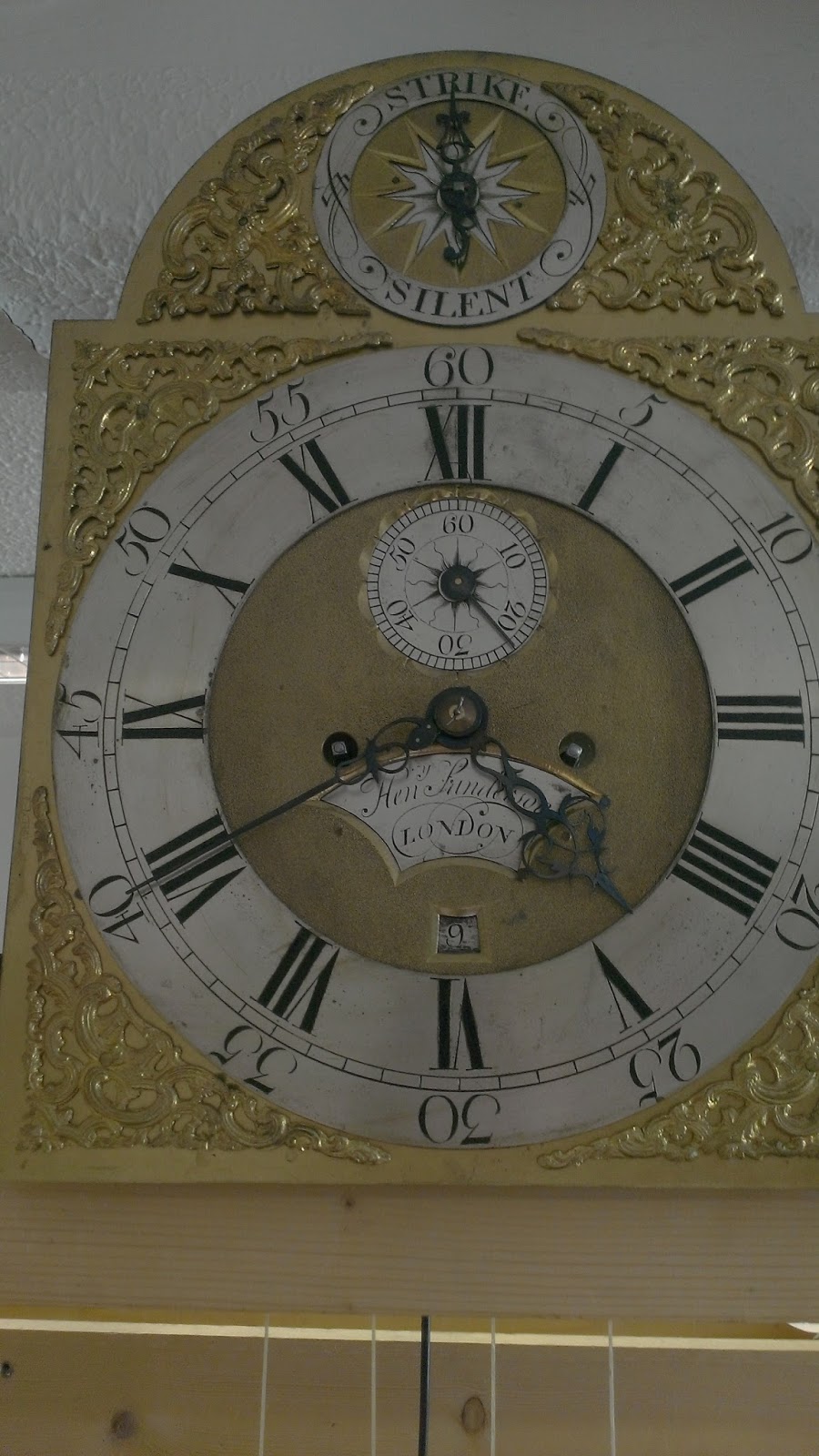
Next I would like to make the pallet arbor crutch. But this can't be fitted until I cut out the top slot in the back plate. Because once it's soldered on I won't be able to get it out unless that slot is cut. But; one of my registering pins is right there in the way, and I need it to help me position and depth the striking train. So the striking train has to be done next all the way up to the fly. Then I can cut out the back plate, so that I can work down towards the pendulum.
Sunday, 15 November 2009
Saturday, 14 November 2009
Making the Anchor
To mark out the steel for the anchor I either clamp the scape wheel directly to the high carbon steel sheet or mark it on paper then scribe from that. This Escapement is a square recoil escapement, square because the pallets span 7 1/2 teeth of the scape wheel which has 30 teeth.
So mark (on the paper) the 7 1/2 points (with a dot of your pen)
Coincidentaly (and this is not critical) the inner circle of your crossed out wheel is approximately right for finding the degree of angle for the two impulse faces (radius= .71). So scribe/draw a line from your dots and across the inner circle so it just touches it, one across the top from the left pallet and one down the right from the right pallet. Next put in the drop-off face angles; from the centre of the wheel draw a line outwards directly to both dots and past, shade in to make clear this is metal to keep.
Next find the position for the anchor arbor. The distance between the arbors is X.
X divided by the radius = 1.41 ~ so the radius multiplied by 1.41 = X.
In this case 1.15.
Use a compass to scribe this line, it doesn't matter too much where along the anchor the arbor hole goes. Place it centrally to look good.
Carve all this out of the steel keeping clear of the scribe lines as it can be shaped little by little in the depthing gauge. Hopefully it should jam as you have made it too big and when it is nearly there finish it off by planting it in the clock. When it is nearly there remember to file/polish down the drop-off faces which shortens the pallet instead of taking too much off the impulse faces making it 'drop' too far.
So mark (on the paper) the 7 1/2 points (with a dot of your pen)
Coincidentaly (and this is not critical) the inner circle of your crossed out wheel is approximately right for finding the degree of angle for the two impulse faces (radius= .71). So scribe/draw a line from your dots and across the inner circle so it just touches it, one across the top from the left pallet and one down the right from the right pallet. Next put in the drop-off face angles; from the centre of the wheel draw a line outwards directly to both dots and past, shade in to make clear this is metal to keep.
Next find the position for the anchor arbor. The distance between the arbors is X.
X divided by the radius = 1.41 ~ so the radius multiplied by 1.41 = X.
In this case 1.15.
Use a compass to scribe this line, it doesn't matter too much where along the anchor the arbor hole goes. Place it centrally to look good.
Carve all this out of the steel keeping clear of the scribe lines as it can be shaped little by little in the depthing gauge. Hopefully it should jam as you have made it too big and when it is nearly there finish it off by planting it in the clock. When it is nearly there remember to file/polish down the drop-off faces which shortens the pallet instead of taking too much off the impulse faces making it 'drop' too far.
Saturday, 31 October 2009
Thursday, 29 October 2009
pinions
Here I make pinion wire. All of my pinions are made out of 5/16" diameter stock on the milling machine. When I have cut all my leaves I can cut off a pinion one at a time at the required length, drill the hole and position on the arbor. A main advantage of fabricating instead of turning the whole arbor & pinion from solid is so that it is much easier to depth the pinions to the wheels using a simple homemade depthing tool. 3 pinions are to have 8 leaves and 4 have 7.
The 3rd and Centre pinions are 8 leaves and both are turned down to the 3/16" to hold their wheels respectively. The Scape, Fly, Warn, and Pallet are 7 leaves. And the Pin is 8 leaves. Pinions and pivots should be hardened and tempered to prevent wear.
Friday, 23 October 2009
Cutting the teeth.
I use a homemade 'wheel cutting engine' to cut my teeth. But the milling machine can be used to do this as well as the lathe can- with a milling head. If preparation and planning is all sorted then all the teeth of the wheels can be cut in an evening.
Make a mandrel: use 1/2" steel rod, turn down one end to the 3/16ths for your wheels. Then thread the end 2 B.A. with a washer and nut to hold the work tight.
Mount your mandrel in a horizontal holder on the machine table with the applicable division plate attached at it's other end.
Centre up your 0.8 module cutter by using a lathe centre point.
Make a mandrel: use 1/2" steel rod, turn down one end to the 3/16ths for your wheels. Then thread the end 2 B.A. with a washer and nut to hold the work tight.
Mount your mandrel in a horizontal holder on the machine table with the applicable division plate attached at it's other end.
Centre up your 0.8 module cutter by using a lathe centre point.
Labels:
clock making,
clock wheels,
grandfather clock,
longcase clock
The Wheels
Seven wheels are cut out of 1/16" Compo brass sheet with a bandsaw. Then turned down to exact measurements on the lathe. The Centre will have 60 teeth and is 1.975" Diameter. 3rd has 56 teeth at 1.849" Dia. Also the Pin wheel has 56 teeth at 1.849" Dia. The Scape has 30 teeth at 1.650" The Pallet has 49 teeth at 1.628", the Warn has 42 at 1.408" the Hour has 72 teeth at 2.353".
There are then two Minute wheels (one for going in reverse) made out of 3/32" material. They have 39 teeth at 1.313" Diameters.
The Centre, 3rd, Pin, Pallet and Warn are pierced out with a jewellers/piercing saw. to have four crossings/spokes each. You can saw and file this to taste bearing in mind the centre bore hole is 3/16", and the Pin wheel has extra 'meat' to house the pins for the Bell hammer tail.
There are then two Minute wheels (one for going in reverse) made out of 3/32" material. They have 39 teeth at 1.313" Diameters.
The Centre, 3rd, Pin, Pallet and Warn are pierced out with a jewellers/piercing saw. to have four crossings/spokes each. You can saw and file this to taste bearing in mind the centre bore hole is 3/16", and the Pin wheel has extra 'meat' to house the pins for the Bell hammer tail.
Arbors
Next is the arbors. Seven. (not including Barrel arbors). The 'Going' gear train runs on three arbors. The Scape, the 3rd, and the Centre. One end of the Scape arbor protrudes through the front plate 7/8" for the seconds hand, and one end of the Centre arbor protrudes through 1 7/8" for the minute hand. A shoulder will need to be made to hold the centre arbor in place (also to carry a wheel) as it's full width passes through the front plate.
The striking gear train - Fly arbor, Warn arbor, Pallet arbot, and Pin arbor. The fly, warn and pin are made the same as the 3rd arbor of the going train. Make them loose fitting (endshake) by offering them up to the chassis for a feel. Turn the pivots to .060 .
The Pallet arbor protrudes through the front plate 7/16".
The striking gear train - Fly arbor, Warn arbor, Pallet arbot, and Pin arbor. The fly, warn and pin are made the same as the 3rd arbor of the going train. Make them loose fitting (endshake) by offering them up to the chassis for a feel. Turn the pivots to .060 .
The Pallet arbor protrudes through the front plate 7/16".
Subscribe to:
Posts (Atom)